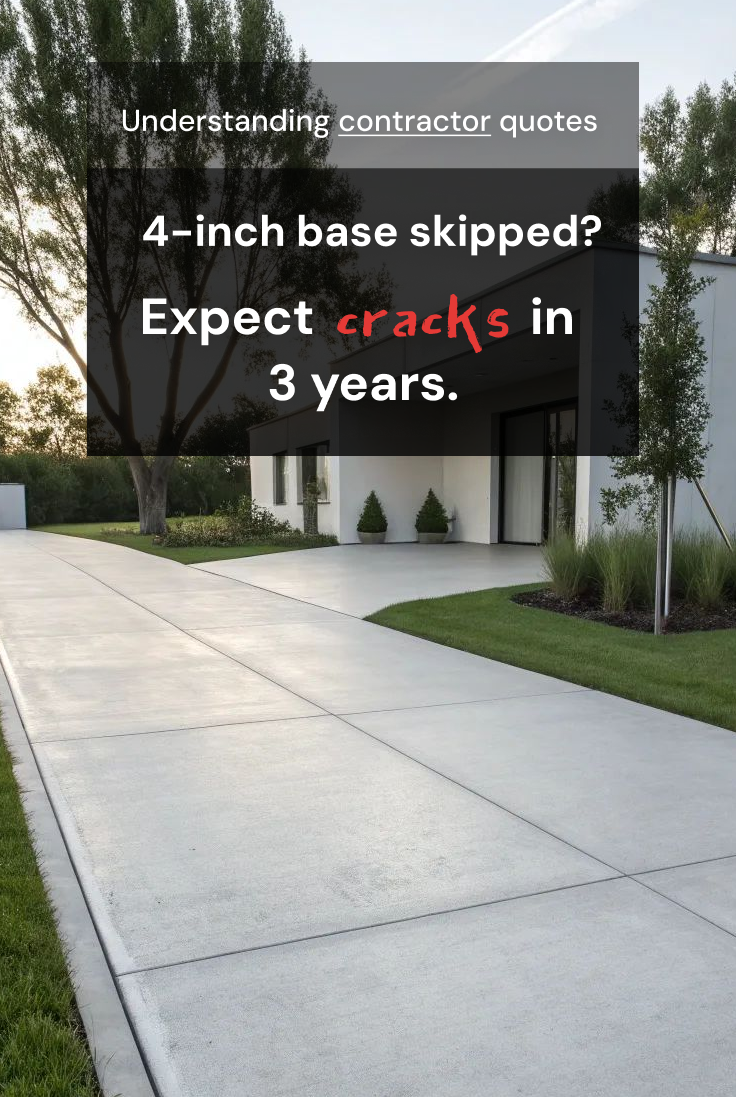
Check your concrete quote: base depth is the real durability number
Why the base fails first
Concrete cracks, shifts, and heaves because the ground underneath moves-not because the concrete mix was weak. A compacted gravel base absorbs moisture, distributes load, and lets water drain. Without it, frost heave and settling destroy slabs in 3–5 years. Most contractors bury this detail in the specs or skip it entirely to hit a lower bid. Your quote should explicitly state base depth and material type.
Base depth requirements by climate
| Climate type | Minimum base depth |
|---|---|
| Warm, dry regions | 4 inches compacted gravel |
| Freeze-thaw zones | 6 inches compacted gravel |
| High water table | 6+ inches with perimeter drain |
Red flags in your quote
- No mention of base depth or material-ask before signing
- Quote lists 2 inches of gravel or "base as needed"-both are cheap shortcuts
- Contractor doesn't describe how gravel will be compacted-matters for settlement prevention
- Price seems 15–20% lower than others-skipped base is a common cut
Most homeowners don't realize the real cost difference between a quote that cuts corners and one that builds a slab to last.
one-click price evaluation
Check if your quote is fair - before you sign.
- Real $/sqft ranges for your project type and region
- PSI, thickness & base depth benchmarks to check the spec
- One-page negotiation reference card
How it works
- Pull up your quote
- Check it against the regional data and spec benchmarks
- See exactly where you're overpaying
Done in 30 seconds.